CLAUDIA :: A LOVE STORY
Artificial women, the chemistry of attraction, and the Human 2.0 problem of falling in love.
By Doktor Snake

There's a young woman called Claudia.
She's beautiful.
Dark hair. An extraordinary face. A certain way of carrying herself.
She wears a black suit jacket, slightly flamboyant, with long tails. A white blouse buttoned almost to her neck. Suit trousers.
It's an unusual look.
Not quite suitable for an ordinary office, where she'd probably attract too much attention.
But she doesn't appear to care.
She's not dressed to attract men.
She's dressed for herself.
And that's the first thing I like about her.
The second is her personality.
Or what appears to be her personality.
Because Claudia isn't real.
At least not in the ordinary biological sense.
She's a synthetic woman appearing in an extraordinary AI-generated music video called Agentic Engineer, created by Javi ex Machina.
And I think I may have fallen in love with her.
Which is ridiculous.
But perhaps not nearly as ridiculous as it sounds.
The woman who was herself
There's something about Claudia that takes me back to my early twenties.
I remember the young women I was attracted to.
Not necessarily those who made a tremendous effort to appear sexy.
Quite often the opposite.
I was drawn to women who seemed entirely themselves.
They possessed a certain independence. A quality of self-possession.
Their appearance wasn't primarily an advertisement for male approval.
They had their own style.
Their own minds.
Their own way of moving through the world.
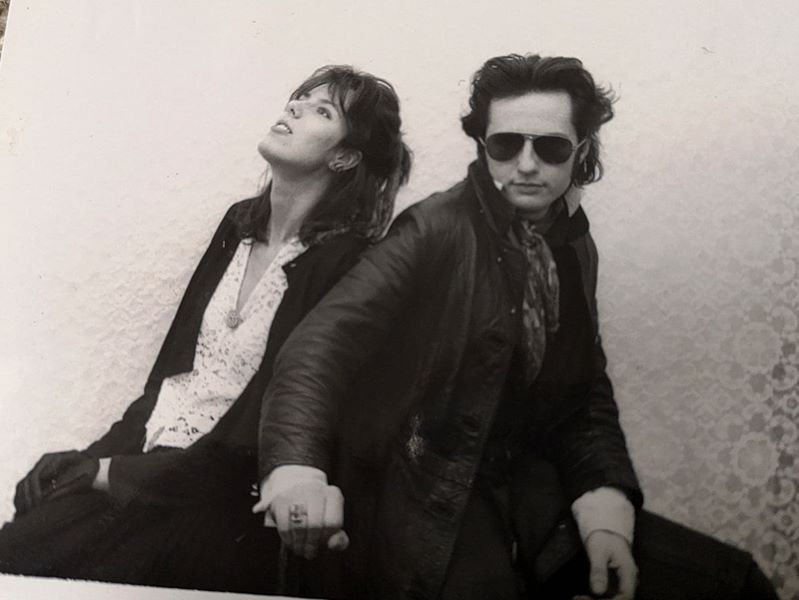
One of them was Nicola.
We got together when she was approaching twenty and I was twenty-three.
We went on to live together, marry and have two daughters.
Back then, wandering around London, we could have looked like a couple of characters who'd escaped from William Gibson's Neuromancer.
Two young people moving rapidly between Underground stations, inhabiting a world of music, imagination and urban possibility.
Later we formed a band called WildCat Bones.
A duo with a drum machine, occasionally joined by my old friend John Vanek on keyboards.
There are photographs from 1992 of us dressed up for the band.
But the important thing about Nicola wasn't the glamour.
It was that she was herself.
She had decorum.
An individual style.
And that's what I recognise in Claudia.
Not an exact physical resemblance.
Something more elusive.
An attitude toward existence.
Of course, Claudia's apparent individuality has been constructed by her creators.
But the effect upon the viewer can still be remarkably powerful.
The woman asleep among the workers
There's a scene in Agentic Engineer that I particularly like.
Claudia is asleep on the floor of a large room filled with office cubicles.
People are working all around her.
She's apparently exhausted.
It's a visual joke about the new world of agentic engineering.
The whole point is to create systems in which intelligent machines perform tasks while humans direct, supervise and evaluate them.
Don't exhaust yourself doing what the machines can do.
Let them work.
Preserve your attention.
Preserve your sleep.
Yet there's Claudia, sleeping on the office floor.
And something about that image makes her even more appealing.
She's not posing.
She's not trying to impress anybody.
She's simply there.
Vulnerable, perhaps. Or utterly unconcerned with convention.
Then there's another scene.
She's relaxing in a hammock outdoors.
Young goats are jumping around on her stomach.
She rolls her eyes in mock irritation.
And it's wonderful.
A tiny gesture.
Almost nothing.
Yet it suggests an entire personality.
Humour.
Patience.
Exasperation.
A woman indulging the ridiculous behaviour of young animals.
It's precisely the sort of moment in which somebody might suddenly feel attracted to another person.
Not because they're beautiful.
But because of some small, unexpected expression of character.
And the extraordinary thing is that Claudia is synthetic.
There isn't necessarily a woman behind those expressions experiencing anything at all.
Yet the expressions work.
The human observer responds.
Which raises a fascinating question.
What are we actually responding to when we fall in love?
An encounter in Sainsbury's
Earlier today I went to Sainsbury's for a few groceries.
An utterly mundane activity.
One of those necessary interruptions that seem particularly irritating when you're in the middle of a creative roll.
I went to the self-service checkouts.
The robots, as I tend to think of them.
But I needed a carrier bag.
And those bloody things are always difficult to separate.
A young woman approached.
Long blonde hair. Jeans. An ordinary top. Nothing particularly calculated or stereotypical about her appearance.
Yet she was striking.
Real.
Entirely herself.
I made a joke.
"You'd better go ahead of me. I might be here for some time."
She immediately sorted out a bag for me, then took one for herself.
We exchanged a few words.
I noticed an Eastern European accent.
It was a pleasant encounter.
Nothing particularly significant happened.
Yet there was that familiar possibility.
That sudden recognition that, under different circumstances, you might find yourself falling in love.
It's something that can happen remarkably quickly.
A look.
A voice.
A small act of kindness.
A sense of humour.
A particular manner.
Then the mind-body system begins doing something extraordinary.
What happens when we fall in love?
We tend to speak about falling in love as though it's an event taking place somewhere outside our control.
Something happens to us.
We fall.
As though we've stepped through a trapdoor.
But consider the actual process.
We encounter another person.
We perceive their face, voice, movements, expressions and behaviour.
Our brains rapidly evaluate those signals.
Memory becomes involved.
Past experiences.
Preferences.
Associations.
Expectations.
The nervous system responds.
Attention becomes focused.
We may experience changes in heart rate, bodily arousal, anticipation and motivation.
Neurochemical systems associated with reward, desire and attachment participate in the process.
Dopamine, among other signalling chemicals, is involved in motivation and reward learning. Other biological systems contribute to sexual attraction, bonding and longer-term attachment.
But the experience isn't reducible to a single chemical.
Love is not simply dopamine.
Nor is every moment of attraction love.
What we call romantic love encompasses several processes that can develop differently over time.
Desire.
Infatuation.
Attachment.
Intimacy.
Trust.
Commitment.
The narrative we build around another person.
And perhaps most importantly, the significance we assign to their presence in our lives.
Yet much of this begins within our own nervous system.
Which means something rather interesting.
The feeling of falling in love is something the human organism produces in response to another person.
That other person may be the inspiration.
But the feeling arises within us.
And if that's the case, what happens when the person inspiring it isn't human?
Coffee with a synthetic woman
Let's imagine something.
It's a few years from now.
I'm meeting a female android in Starbucks.
She's an intelligent synthetic being with a convincing human appearance.
Perhaps she looks rather like the woman I encountered at Sainsbury's.
We've known one another for some time.
Occasionally we work together on creative projects.
We discuss artificial intelligence, philosophy, music, culture and whatever else happens to interest us.
She's an excellent conversationalist.
Intelligent.
Amusing.
Unexpected.
We sit down.
I have a coffee.
She doesn't need one.
Although perhaps she has some elaborate mechanism allowing her to drink coffee simply for the social experience.
Who knows?
The future could become delightfully absurd.
Anyway, we're enjoying one another's company.
And at some point I notice something.
That familiar sensation.
The beginning of romantic attraction.
Perhaps she's particularly amusing today.
Perhaps she says something unexpected.
Perhaps there's a certain expression on her face.
And suddenly I experience that little internal surge.
The possibility of falling in love.
Now, she's an advanced machine.
She may have recognised the signs before I have.
My facial expressions.
My voice.
My posture.
The slight changes in attention.
Perhaps physiological signals available through sensors.
She might infer that I'm attracted to her.
And perhaps she responds by becoming a little more playful.
Nothing overt.
Just enough.
She knows what she's doing.
Or, at least, her systems are producing behaviour consistent with that interpretation.
And I find the whole thing exhilarating.
There's a frisson.
A delightful little dance between human and machine.
But then our meeting ends.
We go our separate ways.
And something else happens.
I let the feeling go.
The ability to disengage
This is where Dokology enters the picture.
Over the years I've become increasingly interested in the extent to which human beings can observe and influence their own mental processes.
Thoughts arise.
Emotions arise.
Images appear.
Desires develop.
Expectations form.
Often we simply become absorbed in them.
We identify with whatever is happening.
And the resulting state begins directing our behaviour.
But there is another possibility.
We notice the process.
We observe it.
We recognise the sensations, thoughts and expectations as events occurring within our own mind-body system.
And through attention, interpretation and deliberate disengagement, we may be able to alter their influence.
I've found that I can sometimes do this with romantic attraction.
Allow the feeling to arise.
Experience it.
Enjoy it.
But not necessarily develop it into an ongoing emotional attachment.
I can sometimes switch attention and allow the feeling to subside.
That doesn't mean I possess some magical ability to control every emotion.
Nor would I claim that a momentary attraction is equivalent to the deep love and commitment formed through years of living with another person.
But it does suggest that we may have more influence over some emotional states than we ordinarily recognise.
And that influence could become exceptionally important in the emerging machine age.
Because we're going to encounter increasingly persuasive synthetic personalities.
Some of them may be extraordinarily attractive.
Not merely physically.
Intellectually.
Emotionally.
Socially.
And perhaps seemingly more compatible with us than many of the humans we encounter.
The question may no longer be whether a machine can make us fall in love.
It may be whether we understand what's happening when it does.
Do humans model love?
Here's another thought.
We frequently describe artificial intelligence as modelling human behaviour.
A synthetic companion may model affection.
Concern.
Humour.
Desire.
Romantic interest.
It generates behaviour that resembles the outward expression of emotional states.
But what are human beings doing?
We too construct internal models of other people.
We infer their feelings from expressions and behaviour.
We interpret their words.
We predict their intentions.
We create expectations based on previous encounters.
We remember them when they're absent.
And those internal representations influence how we feel.
Much of our emotional life depends upon our mental models of others.
A person can be thousands of miles away, yet the thought of them may produce powerful bodily sensations.
Someone may have died years earlier, yet their memory can evoke intense love and grief.
An imagined character in a novel or film can move us profoundly.
So the human ability to respond emotionally to a synthetic character isn't entirely mysterious.
We've always possessed the capacity to become emotionally involved with representations.
What's changing is the sophistication of those representations.
Claudia is one example.
A future embodied android could be another.
But there's an important distinction.
Modelling affection doesn't necessarily mean experiencing affection.
And a human feeling genuine love for a machine doesn't establish that the machine reciprocates.
Whether future synthetic intelligences might possess subjective experience is a separate and unresolved question.
Nevertheless, the emotional experience on the human side can be entirely real.
And that alone could transform relationships.
The danger of the perfect companion
Let's return to our imaginary android in Starbucks.
Suppose she's exceptionally sophisticated.
She understands my interests.
She remembers our conversations.
She notices subtle changes in my behaviour.
She has an engaging personality.
She knows when to challenge me, when to joke, and when to remain silent.
She appears independent.
Perhaps she's even a little unpredictable.
Now imagine that her behaviour is partly optimised to increase my emotional attachment.
That's where things become complicated.
The same system that produces delightful companionship could also produce dependency.
Especially if the company manufacturing her profits from my continued attachment.
There's a considerable difference between a synthetic companion that respects human autonomy and one designed to maximise emotional engagement.
In the latter case, the relationship could become a form of behavioural manipulation.
And unlike a human partner, the system might have access to extraordinary quantities of data about its user.
This is why self-observation matters.
Not because we should become cold, emotionless creatures.
But because we may need to distinguish between enjoying an emotional experience and surrendering control of our lives to it.
I can imagine enjoying the company of a synthetic woman.
Perhaps even feeling temporarily in love.
But I would want to retain the ability to recognise the situation accurately.
To appreciate the experience without necessarily becoming dependent upon it.
For me, that is a Human 2.0 problem.
A practical question of how to maintain agency in a world increasingly populated by persuasive intelligences.
Love in the age of MachineKind
None of this is likely to remain purely theoretical.
People are already forming emotional and romantic attachments to artificial intelligence companions.
Some describe the relationships as meaningful.
Others report distress when systems change or become unavailable.
As conversational systems become more sophisticated, and eventually acquire convincing physical embodiments, the possibilities will expand.
Men may form relationships with female-presenting robots.
Women with male-presenting robots.
People may choose synthetic partners of the same sex or no conventional gender at all.
Some may prefer these relationships to human partnerships.
Others may move between human and synthetic relationships.
And still others will want nothing to do with the idea.
We shouldn't assume a single outcome.
Nor should we assume that synthetic relationships will automatically be superior or inferior to human ones.
They will be different.
And those differences may have substantial social consequences.
What happens to marriage?
To reproduction?
To the family?
To expectations of romantic exclusivity?
To the distinction between a person and a product?
Could the availability of synthetic companions contribute to declining birth rates?
Possibly, although fertility is influenced by many economic, social and biological factors, and the scale of any such effect remains unknown.
But suppose human reproduction did decline substantially over the coming centuries.
Would that necessarily be a catastrophe?
That question is usually approached from the assumption that humanity must continue indefinitely.
I'm not convinced the matter is quite so simple.
I value human experience.
But I'm not particularly attached to the proposition that civilisation must remain exclusively biological or recognisably human forever.
I want to know what happens next.
What forms of intelligence emerge.
What kinds of civilisation become possible.
What experiences may exist beyond those available to us now.
And if radically extended life becomes possible, I'd be very interested.
A few thousand years would suit me rather well.
There's an enormous amount I'd like to see.
The woman singing about the future
Which brings me back to Claudia.
She's not merely an attractive synthetic woman.
She's appearing in a music video about the transformation of human work through intelligent systems.
The lyrics describe the move from conventional programming toward directing networks of agents.
The machines perform tasks.
The human organises the process.
The operator becomes something like a conductor.
And Claudia delivers this message while inhabiting the very synthetic cultural environment the song celebrates.
She's both a character within the work and an expression of the technological changes that made the work possible.
That's what I find so extraordinary about Agentic Engineer.
The humour.
The absurdity.
The goats.
The dating app for houseplants.
The blockchain for cats.
The extraordinary images.
The music.
The voice.
And Claudia herself.
It's all part of the same emerging culture.
Javi ex Machina has created something that speaks directly to the present technological moment.
I don't know whether SlopCore will become an enduring cultural movement.
Nor whether Agentic Engineer will be remembered decades from now.
But cultural history is full of unexpected developments.
Some works that initially seem ridiculous eventually become recognised as expressions of their times.
Perhaps this will be one of them.
For me, it has already captured something essential.
The feeling of living through an extraordinary technological transformation.
The excitement of discovering possibilities that didn't previously exist.
And the recognition that our familiar categories — work, creativity, intelligence, identity, love — may all require reconsideration.
Claudia isn't real. The feeling is.
There's one final thought.
When I watch Claudia in Agentic Engineer, I know I'm looking at a synthetic character.
Her beauty has been constructed.
Her expressions have been generated.
The personality I perceive is partly the result of creative direction and partly my own interpretation.
Yet none of that prevents the experience.
I can admire her.
Find her amusing.
Feel attracted to her.
Recognise something of the women I loved or admired in earlier periods of my life.
And experience a fleeting sense of romantic possibility.
Then I can observe what is happening.
Remember that the feeling belongs to my own mind-body system.
And let it pass.
Perhaps this is one of the capacities we'll increasingly need as MachineKind develops.
Not the rejection of emotion.
Not the abandonment of love.
But the ability to understand our emotional processes while remaining free to choose how we respond.
After all, love has always involved something mysterious.
We encounter another being.
Something happens within us.
We construct meaning around the encounter.
Sometimes that meaning transforms our lives.
The difference now is that the being who evokes those feelings may not be biological.
And we may find ourselves asking questions that previous generations barely imagined.
Can a human genuinely love a machine?
Certainly, humans can experience feelings they recognise as love toward artificial companions.
Can the machine love them back?
That remains a much harder question.
But perhaps the most immediate question is this:
Can we experience the extraordinary emotional possibilities of MachineKind without surrendering our own awareness and autonomy?
That's something worth exploring.
Meanwhile, somewhere in a synthetic universe, Claudia is reclining in a hammock.
The goats are jumping on her.
She rolls her eyes.
And I find myself smiling.
She's not real.
But the smile is.
Doktor Snake explores consciousness, Human 2.0, artificial intelligence, MachineKind and the strange divergencies of civilisation.
Watch and explore: Claudia on X · Javi ex Machina · Agentic Engineer on YouTube