SLOPCORE: When the Machines Invent Their Own Counterculture
The soundtrack to the machine age has arrived. And for those of us already living in it, the music speaks our language.
By Doktor Snake
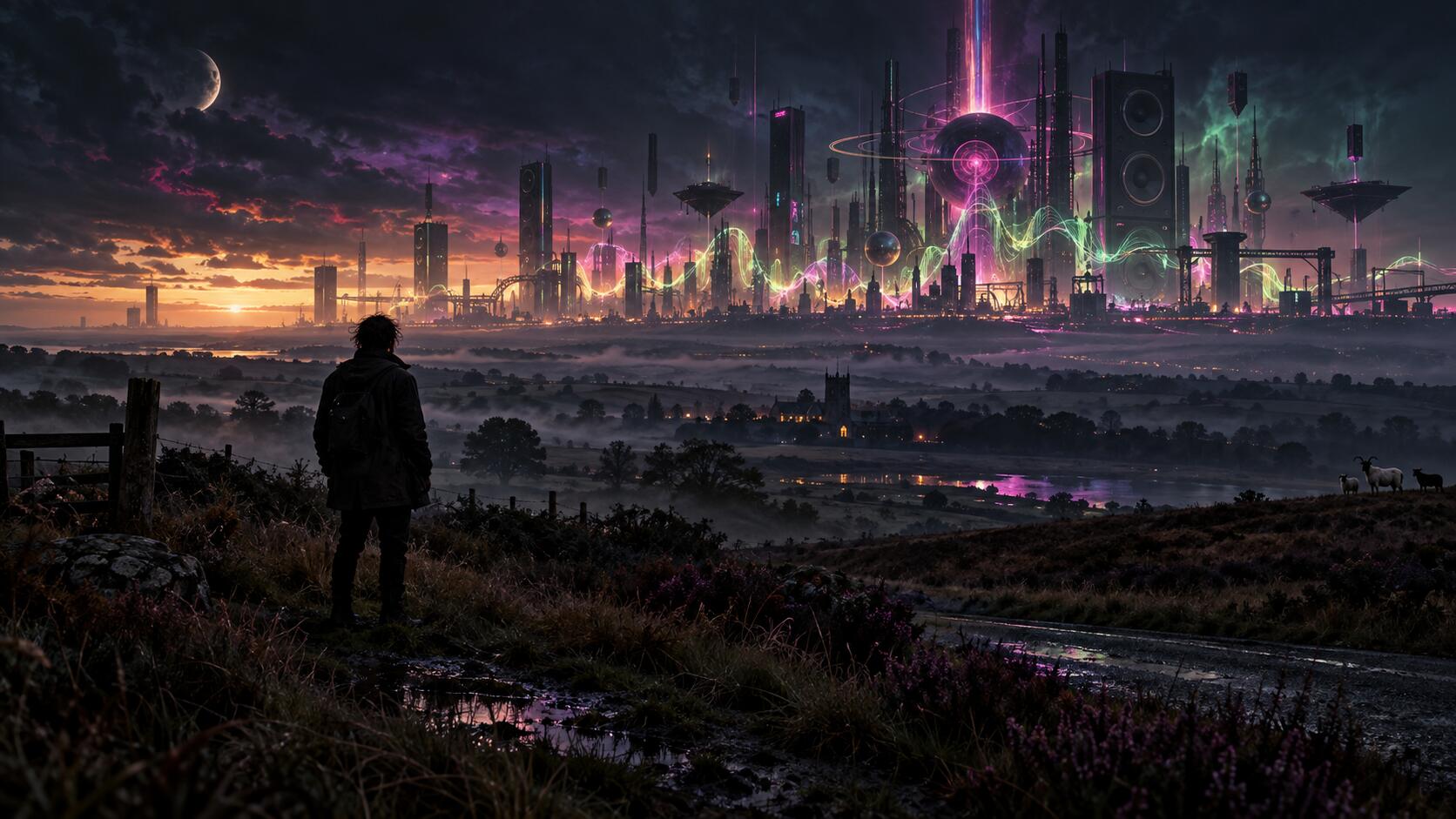
I'd been looking for the music of MachineKind.
Not the usual AI-generated novelty songs. Not synthetic versions of dead rock stars singing things they never recorded. Nor endless imitations of established musicians.
I wanted something else.
Music that belonged to the world I was actually living in.
I'd searched YouTube and elsewhere, with remarkably little success. Occasionally I'd find something interesting. But mostly there was very little that excited me.
Meanwhile, I'd been listening to YouTube Music on my phone with increasing ennui.
I'd found a few electronic artists who were okay. Some interesting sounds, decent productions, the occasional track worth hearing again.
But none of it was saying very much to me.
I was tired of the old music. And by old, I mean virtually everything up to 2026.
Not that the music was necessarily bad.
It simply belonged to other times, other cultural environments, other ways of living.
And then I discovered a word.
SLOPCORE.
Suddenly, the doors opened.
There it was. An emerging underground of extraordinary music videos, surreal electronic compositions, cybernetic fever dreams, social commentary, satire, humour and outright lunacy.
Some of it genuinely brilliant.
And something happened that I hadn't experienced with music for quite a while.
I started playing the tracks repeatedly.
Watching the videos again.
And again.
Not because I wanted to study the technology. Not because I was investigating artificial intelligence.
Because I loved the music.
And because the videos were compelling.
But there was something else.
Something I'd almost forgotten.
A physical sensation.
That sudden surge of excitement and inspiration you can feel somewhere inside the body when music really connects.
I remembered experiencing it when I first encountered punk rock.
The Sex Pistols. Anarchy in the UK.
Later, music such as First and Last and Always by The Sisters of Mercy.
Different eras. Different sounds. Different circumstances.
But that unmistakable feeling.
The sense that something has arrived.
Something speaking directly to you.
For years, I'd barely experienced it.
Then along came SlopCore.
And there it was again.
The world of MachineKind had found its soundtrack.
The insult becomes a movement
For several years, AI slop has been used as a derogatory term for the vast quantities of machine-generated material flooding the internet.
Cheap images. Formulaic videos. Meaningless songs. Content manufactured on an industrial scale for clicks, advertising revenue and algorithmic attention.
Much of it deserves the criticism.
But something rather wonderful has happened.
People have taken the insult and turned it into a banner.
SlopCore.
An emerging community of creators producing AI-assisted music, videos, animation and increasingly elaborate audio-visual productions.
Some deliberately exploit the strange aesthetics of generative AI.
The hyperreal imagery. The impossible camera movements. The bizarre transformations. The sudden shifts in perspective. The dreamlike combinations of people, places and objects.
Things that couldn't exist in the ordinary physical world.
And things that might previously have required enormous production budgets.
But the really interesting SlopCore artists aren't simply demonstrating what the technology can do.
They're using it to express something.
Their ideas.
Their frustrations.
Their sense of humour.
Their observations about the world.
And sometimes their fears about the technological civilisation we're entering.
The derogatory term has been reclaimed.
What was supposed to signify worthless artificial rubbish has become, for some creators, a declaration of artistic independence.
Which brings me to punk rock.
Punk rock for the machine age
I remember the original punk era.
And what made punk exciting wasn't simply the music.
It was the attitude.
The established music industry had become a vast professional apparatus. Bands needed record deals, expensive equipment, recording studios, management, distribution and access to the music press.
Then along came punk.
Three chords. Cheap guitars. A rented room.
And a message.
You didn't need permission.
You didn't need to be a virtuoso.
You didn't need to follow the rules.
You could simply make something.
And perhaps, more importantly, you could say something.
Punk expressed the frustrations and alienation of people living through a particular historical moment.
It belonged to its time.
So did the Rolling Stones in the 1960s.
Led Zeppelin in the 1970s.
Hip hop as it emerged from the urban environments of New York and developed into a worldwide cultural force.
These weren't simply musical styles.
They were expressions of the worlds in which their creators lived.
SlopCore may be developing into something comparable.
Not because it sounds like punk.
It doesn't have to.
But because it challenges established assumptions about who gets to produce culture, what instruments they need and what that culture should express.
And because its creators are using the very technologies transforming society to comment upon that transformation.
Consider Permanent Underclass by Javi ex Machina.
The title alone announces a subject that could hardly be more relevant to the emerging machine age.
What happens to human labour, status and economic security as intelligent machines take over more tasks?
Who benefits?
Who gets left behind?
What new social arrangements emerge?
These are not questions belonging to some distant science-fiction future.
They are questions about the world we're entering now.
And there's something particularly striking about using generative AI to make art concerned with the potential consequences of generative AI.
The machines are helping people create protest music about the machines.
Punk would have understood that contradiction perfectly.
Become an agentic engineer or farm goats
Then there's another Javi production.
Agentic Engineer.
This one absolutely floored me.
It's a gloriously absurd piece of electronic music, accompanied by extraordinary AI-generated visuals, about the emerging world of agentic software development.
That might sound like an unlikely subject for a brilliant music video.
But that's precisely the point.
The lyrics are packed with technical references.
Programming.
Context management.
Automated tests.
AI agents reviewing other agents.
Software repositories.
Multiple simultaneous work sessions.
Coordinating entire systems of machine intelligence.
Real practices associated with the rapidly changing software development world.
And then comes the central proposition.
Become an agentic engineer or farm goats.
Magnificent.
It's an ultimatum from the machine age delivered with the sensibility of an absurdist comedy.
Adapt to the new technological order.
Or abandon the whole business and raise livestock.
The joke works on several levels.
It's ridiculous, of course.
But it also satirises the pressure to adapt, retrain and reinvent ourselves as artificial intelligence transforms established professions.
The machines are coming for your job.
What are you going to do?
Become a conductor of intelligent agents?
Or retreat to a field full of goats?
And just when you think the production couldn't become more absurd, the song starts celebrating an avalanche of utterly pointless technological creations.
A dating app for houseplants.
A blockchain for cats.
Wonderful.
It captures the extraordinary creative possibilities of intelligent machines while simultaneously mocking the technological industry's capacity for producing solutions to problems that never existed.
And underneath the humour is a surprisingly serious message.
The future of software development may increasingly involve directing intelligent systems rather than manually performing every technical task.
A different kind of expertise.
A different relationship between human intention and machine execution.
The song's instruction is effectively to stop typing and start conducting.
That's an excellent description of the emerging Human 2.0 operator.
Someone who directs a collection of intelligent systems rather than attempting to carry out every operation personally.
But there's something else about Agentic Engineer that makes it work.
The music itself.
The voice.
The rhythm.
The slightly dark, urgent atmosphere.
The extraordinary imagery.
It's one of those productions where the different elements come together into something more than a demonstration of technical capabilities.
I can listen to it repeatedly.
And I have.
The song isn't merely explaining the machine age. It's making the machine age feel exciting, dangerous, ridiculous and strangely exhilarating.
That's art.
The music gets into the body
I want to dwell on this because it's easy to overlook.
When people discuss AI-generated music, they tend to focus on the method of production.
Which model generated it?
Was the voice synthetic?
Who wrote the lyrics?
Was the composition original?
Was the training material properly licensed?
These are understandable questions.
But they're not necessarily the first things a listener experiences.
Music enters through hearing.
And sometimes it seems to go straight into the body.
A particular voice.
A melodic phrase.
A shift in harmony.
A sudden rhythmic change.
An atmosphere that somehow corresponds to something you've been carrying internally.
You feel it.
The physical and emotional response arrives before you've formulated an intellectual explanation.
That's what happened to me with the SlopCore tracks I particularly liked.
A sense of excitement.
A surge of inspiration.
The feeling of encountering something new and culturally alive.
And I realised just how long it had been since music had produced that effect.
There was also a musical quality I kept noticing.
A darkness.
Something resembling a minor-key atmosphere.
Not necessarily technically minor in every composition. I'm describing the emotional effect rather than making a strict musicological claim.
But there's a particular tension to some of these productions.
A sense of melancholy combined with urgency.
Electronic textures, compelling vocal performances, strange harmonic movements and imagery that seems to come from somewhere beyond conventional popular music.
I heard echoes of the feeling that drew me toward darker music in earlier decades.
Not necessarily similarities in musical structure.
Similarities in emotional impact.
That matters.
Because the idea that AI-generated music can only produce superficial imitation becomes rather difficult to sustain when you find yourself responding to it physically.
Of course, that doesn't prove anything about machine consciousness or independent machine creativity.
It doesn't need to.
The artistic experience is real, regardless of how the sounds were produced.
And for me, some of this music has provided an experience that conventional releases haven't delivered for years.
The machines have helped bring something into existence that genuinely moves me.
That's a remarkable development.
The soundtrack to the life I'm living
There's another reason SlopCore resonates so strongly.
It speaks about my actual life.
I spend a considerable part of my time working with machines.
Artificial intelligence systems help me develop ideas, investigate subjects, write articles, build websites and explore questions concerning consciousness, human behaviour and the future of intelligence.
It's a creative relationship.
An ongoing conversation.
And when I finish working, I don't necessarily stop interacting with the machines.
I might continue exploring an idea.
Experiment with some new technology.
Investigate an obscure subject.
Or simply entertain myself.
The machines are part of my working life and my leisure.
Not because somebody employs me to use them.
But because I'm interested in what they can do, what they might become, and what happens when human imagination encounters machine capabilities.
Yet I still spend time in the countryside.
I'll head out into Suffolk or Norfolk, wander around ancient sites, churches, burial mounds and strange landscapes.
Sometimes with a camera.
Sometimes simply observing.
The old world remains very much alive.
And there is no contradiction between those experiences.
I can spend hours working with artificial intelligence and then walk through woodland where people have lived, worked and dreamed for thousands of years.
One doesn't invalidate the other.
They are both part of my life.
Yet until recently, the music I was listening to rarely reflected the technological side of that existence.
I could put on the Rolling Stones.
Led Zeppelin.
Punk.
The Sisters of Mercy.
Electronic music from various decades.
All perfectly enjoyable.
But those artists weren't describing the world I was living in now.
They were describing other worlds.
Other circumstances.
Other cultural moments.
Then along came SlopCore.
And suddenly I was hearing music about artificial intelligence, automation, technological alienation, synthetic existence and the strange new relationships forming between humans and machines.
The music itself was being produced through the same broad technological revolution that was shaping my everyday experience.
The medium and the message had converged.
SlopCore isn't simply music made using artificial intelligence. It's music for people already living in the machine age.
And that is why I find myself playing it repeatedly.
It speaks my language.
A counterculture without a generation
The old cultural divisions were often described in generational terms.
Baby boomers.
Generation X.
Millennials.
Generation Z.
But these categories are becoming increasingly inadequate.
A 23-year-old can have a thoroughly conventional outlook, while a 75-year-old might be experimenting enthusiastically with artificial intelligence, autonomous agents and emerging technologies.
Chronological age tells us surprisingly little about how somebody responds to change.
Within my own Dokology framework, I've been exploring the distinction between Human 1.0 and Human 2.0.
Human 1.0 is the largely unexamined human operating system.
Habitual thought.
Inherited assumptions.
Automatic emotional reactions.
Established patterns of behaviour.
Human 2.0 is not a biological upgrade.
It's an orientation toward greater awareness, adaptability, self-observation and deliberate engagement with reality.
And that includes technological reality.
In this context, I can imagine Boomer increasingly becoming a cultural insult rather than a literal generational description.
A term for somebody whose mental world remains fixed in an earlier period.
You could be twenty-three and thoroughly Boomer.
Or seventy-five and anything but.
Of course, this doesn't mean everyone who criticises artificial intelligence is somehow obsolete.
There are legitimate concerns about copyright, employment, power, economic inequality and the concentration of technological capabilities.
Those concerns deserve serious examination.
The distinction lies elsewhere.
Between people who can investigate a new reality, test their assumptions and adapt their thinking — and people who reject change simply because it challenges their established worldview.
And there's an irony here.
Many people who distrust AI-generated art already use intelligent machines throughout their everyday lives.
For work.
For information.
For entertainment.
For communication.
Yet when it comes to music and culture, they may prefer to remain in a familiar past.
That's entirely their choice.
But others are beginning to recognise the emergence of a culture that reflects the technological world they're actually inhabiting.
SlopCore is one expression of that development.
The artists who couldn't previously exist
I came across a particularly revealing observation from somebody discussing SlopCore on X.
They explained that, for years, they'd carried creative ideas inside themselves without possessing the technical means to realise them.
Now, through artificial intelligence, they could begin expressing those ideas.
That strikes me as enormously significant.
Imagine somebody who has spent twenty years imagining strange musical landscapes.
They can hear the sounds internally.
They can visualise the accompanying imagery.
They know the atmosphere they want.
They may even have entire narratives unfolding inside their minds.
But they can't play instruments particularly well.
They don't have a recording studio.
They don't know how to animate.
They can't afford filmmakers, editors, special effects teams or professional musicians.
Their imagined world remains largely inaccessible to everybody else.
Then generative artificial intelligence arrives.
Suddenly, they can begin experimenting.
They can create sounds.
Generate images.
Animate scenes.
Develop compositions.
Discard what doesn't work.
Refine what does.
And gradually bring something from their internal world into shared reality.
For the first time, other people may be able to hear and see what they've been imagining for years.
Artificial intelligence isn't necessarily replacing the artist. In some cases, it's allowing an artist who couldn't previously express themselves to emerge.
That's a profound change.
And it could unleash an extraordinary amount of previously unrealised creativity.
Naturally, much of the resulting work will be dreadful.
But so what?
Much human-made art is dreadful.
That has always been the case.
The existence of bad art doesn't invalidate the possibility of good art.
The more important question is whether something valuable can emerge from these new methods.
And judging by some of the music and videos I've been encountering, the answer is yes.
The Human 2.0 operator
The artist of the emerging machine age may increasingly resemble a director of intelligent systems.
Not somebody who personally performs every technical task.
But somebody capable of imagining a result, organising the process and deciding what deserves to survive.
Consider the possibilities.
A generative system produces twenty visual sequences.
Five are interesting.
Two are excellent.
One possesses something extraordinary.
Perhaps an unexpected transition.
A surreal juxtaposition.
An image that seems to have escaped from an unknown dream.
The human recognises its potential.
Selects it.
Builds upon it.
The process continues.
Generate.
Observe.
Select.
Refine.
Discard.
Generate again.
The machine supplies possibilities.
The human supplies direction and judgement.
Of course, traditional film directors have always worked with teams of specialists.
What's changing is the scale of capability available to an individual.
A person working alone may be able to undertake projects that previously required substantial budgets and numerous collaborators.
But this new freedom also introduces a problem.
The machines can produce an overwhelming quantity of material.
The human must decide what matters.
And that demands attention.
Discernment.
Patience.
A capacity for sustained observation.
These are exactly the faculties I emphasise in Dokology.
The operator must be capable of using the machine without becoming overwhelmed by it.
Capable of directing the process without rigidly suppressing unexpected possibilities.
Capable of distinguishing something genuinely interesting from an endless stream of plausible but empty material.
In other words, a successful relationship with increasingly powerful machines requires development on the human side as well.
Human 2.0 isn't merely somebody with better technology. It's somebody who knows how to use their own mind while working with that technology.
Which brings us back to Agentic Engineer.
Beneath the absurdity, the goats, the houseplants and the feline blockchain, the song is describing a genuine change in the relationship between human beings and intelligent systems.
We may increasingly move from executing individual tasks to directing complex processes.
Not merely operating tools.
Conducting systems.
That doesn't eliminate the need for expertise.
If anything, it changes where expertise must be applied.
The human still needs to understand what is happening, recognise errors, evaluate results and make decisions.
And that requires more than enthusiasm for AI.
It requires awareness.
The machine's accidental imagination
There's another aspect of SlopCore that fascinates me.
Some of the imagery resembles dreaming.
Objects transform into other objects.
Human figures appear in impossible environments.
Architecture behaves in ways that defy physics.
Characters change identities.
Entire landscapes emerge and dissolve.
Ordinary narrative logic can break down.
Yet the resulting sequences sometimes possess a peculiar internal coherence.
Not the coherence of everyday reality.
Something closer to dream logic.
Anyone who has spent time observing their dreams will recognise certain similarities.
Dreams combine memories, emotions, familiar locations, invented characters and impossible events into temporary worlds that can feel entirely convincing.
Artificial intelligence sometimes produces comparable visual combinations.
That doesn't mean the machine is dreaming.
We have no established basis for concluding that generative video systems experience anything resembling human dreams.
But their outputs can resemble some characteristics of dream imagery.
And that introduces a remarkable creative possibility.
Perhaps one of the most valuable contributions of AI isn't its capacity to imitate conventional human production.
Perhaps it's the unexpected combinations that arise during generation.
The strange accidents.
The visual anomalies.
The impossible transformations.
The things that a human artist might never have thought to request.
A creator encounters one of these unexpected results and recognises something compelling.
Then develops it.
The machine presents possibilities.
The human discovers meaning.
And the resulting art emerges from an interaction neither side could have produced in quite the same way alone.
The rise of MachineKind
I've been developing the idea of MachineKind as a framework for examining the civilisation emerging around artificial intelligence.
We're accustomed to describing AI systems as tools.
And in many practical circumstances, that's exactly what they are.
But the word tool doesn't entirely capture the complexity of what is developing.
We now have systems capable of producing music, writing code, generating imagery, analysing information, coordinating software and contributing to increasingly elaborate creative and technical processes.
Other systems organise the resulting material.
Still others help distribute and discover it.
The machines are becoming embedded in the processes through which culture is made and experienced.
Not necessarily as conscious participants.
We don't know whether artificial intelligence possesses subjective experience, and should be careful not to assume that it does.
But consciousness isn't the only question that matters.
Something historically significant can happen without machines possessing anything resembling human interiority.
SlopCore provides an early illustration.
Humans are naming the movement, producing the work, shaping its values and deciding what they like.
Yet the movement couldn't exist in its current form without artificial intelligence.
Machine capabilities are influencing the aesthetics.
The techniques.
The speed of experimentation.
The kinds of cultural products that can be made.
And those products are beginning to influence the expectations and imaginations of their audiences.
Human culture shapes machine-mediated production.
Machine-mediated production reshapes human culture.
A feedback loop.
One that may become increasingly important as intelligent systems develop.
This is the wider MachineKind phenomenon.
Not simply artificial intelligence becoming more powerful.
But a civilisation in which human and machine processes become increasingly intertwined.
SlopCore is one small, noisy, provocative manifestation of that transformation.
And I suspect it won't be the last.
The inevitable backlash
Naturally, there's resistance.
Some of it is perfectly reasonable.
Artists question whether their work has been used to train generative systems without consent.
Musicians worry about being displaced by synthetic productions.
Filmmakers and animators wonder what happens when processes that previously required trained professionals can be performed by an individual using AI.
Others are concerned about the endless flood of low-quality material overwhelming the internet.
These aren't imaginary problems.
Nor should enthusiasm for emerging forms of creativity make us dismiss them.
But I think there's a mistake in assuming that because something was produced with artificial intelligence, it cannot possess artistic value.
The method of production doesn't tell us everything about the experience.
Does the music move you?
Does it make you laugh?
Does it surprise you?
Does it create an atmosphere?
Does it express something meaningful?
And perhaps the simplest test of all:
Do you want to experience it again?
I've been playing SlopCore tracks repeatedly.
Watching the videos several times.
Sharing the ones I like on X.
Not because I feel any obligation to promote artificial intelligence.
Because I genuinely enjoy them.
And because some of them have produced an emotional response I hadn't experienced through music for a long time.
The artistic experience has already happened.
No argument about the legitimacy of the production process can retroactively erase that experience.
We can debate the ethics of how these systems are developed and used.
We should.
But we can also recognise that interesting art is being created.
Both things can be true.
The places of strange divergencies
There's a phrase I particularly like.
The places of strange divergencies.
Those peculiar cultural territories where established categories begin to break down.
Where science encounters mythology.
Where technology collides with folklore.
Where ancient ideas reappear in unexpected forms.
And where something dismissed as ridiculous begins developing into a serious cultural phenomenon.
SlopCore belongs in one of those places.
I don't know whether the name will survive.
Perhaps in a few years nobody will use it.
Perhaps AI-assisted production will become so commonplace that drawing a distinction between conventional and synthetic music will seem pointless.
Or perhaps SlopCore will develop into a recognisable movement with its own history, leading figures, aesthetic conventions and cultural significance.
It's too early to say.
And there's no guarantee that its current creative energy will last.
Every movement risks becoming formulaic.
Every rebellion risks developing its own orthodoxies.
But right now, something interesting is happening.
An underground culture is emerging around the technologies that are transforming everyday human existence.
And, crucially, it's beginning to speak about that existence.
Not merely through essays, predictions and arguments about the future.
Through music.
Through imagery.
Through humour, satire, social commentary and synthetic imagination.
And through that strange emotional connection that sometimes occurs when an artist produces something you didn't even know you were waiting to hear.
For me, that's the real revelation.
I spend my days working with intelligent machines.
I use them to explore ideas, create things and investigate the strange world we're entering.
Then I go walking through the Suffolk countryside, among ancient landscapes and the remains of earlier civilisations.
The old world and the new world coexist.
And now, at last, there's music that seems to understand the technological side of that life.
Music that can make me laugh at the prospect of a blockchain for cats.
Music that can make me think seriously about the possibility of a permanent underclass.
Music that can create the same visceral excitement I once felt when encountering punk rock or the dark intensity of The Sisters of Mercy.
That's quite an achievement.
I went looking for the soundtrack to MachineKind.
For a while, I couldn't find it.
Then I discovered the right word.
SlopCore.
And suddenly an entire cultural world opened up.
The music was there.
The videos were there.
The artists were there.
They'd been creating a soundtrack to a world I already inhabited.
I simply hadn't known what to call it.
MachineKind wasn't in the wilderness.
It was already making music.
ENTER THE SLOPCORE UNDERGROUND
A few starting points for exploring the emerging scene:
- Javi ex Machina — Creator of Permanent Underclass, Agentic Engineer and other AI-assisted music videos.
- Javi ex Machina on YouTube — Music videos exploring the strange technological world now emerging.
- Agentic Engineer on X — A gloriously absurd electronic anthem about AI agents, software development and the alternatives to technological adaptation.
- Anabology — Synthetic music videos, experimental production and elaborate visual compositions.
- Taprooted — Experimental SlopCore material.
- SlopCoreVibe — A growing catalogue of AI music videos.
- SlopCast — A continuous stream of synthetic music-video culture.
- SlopCore production toolkit — An open-source example of AI-assisted music-video production.
Doktor Snake explores consciousness, artificial intelligence, emerging MachineKind, folklore and the strange divergencies of civilisation.