The Third Mind: Who Is Writing the World?
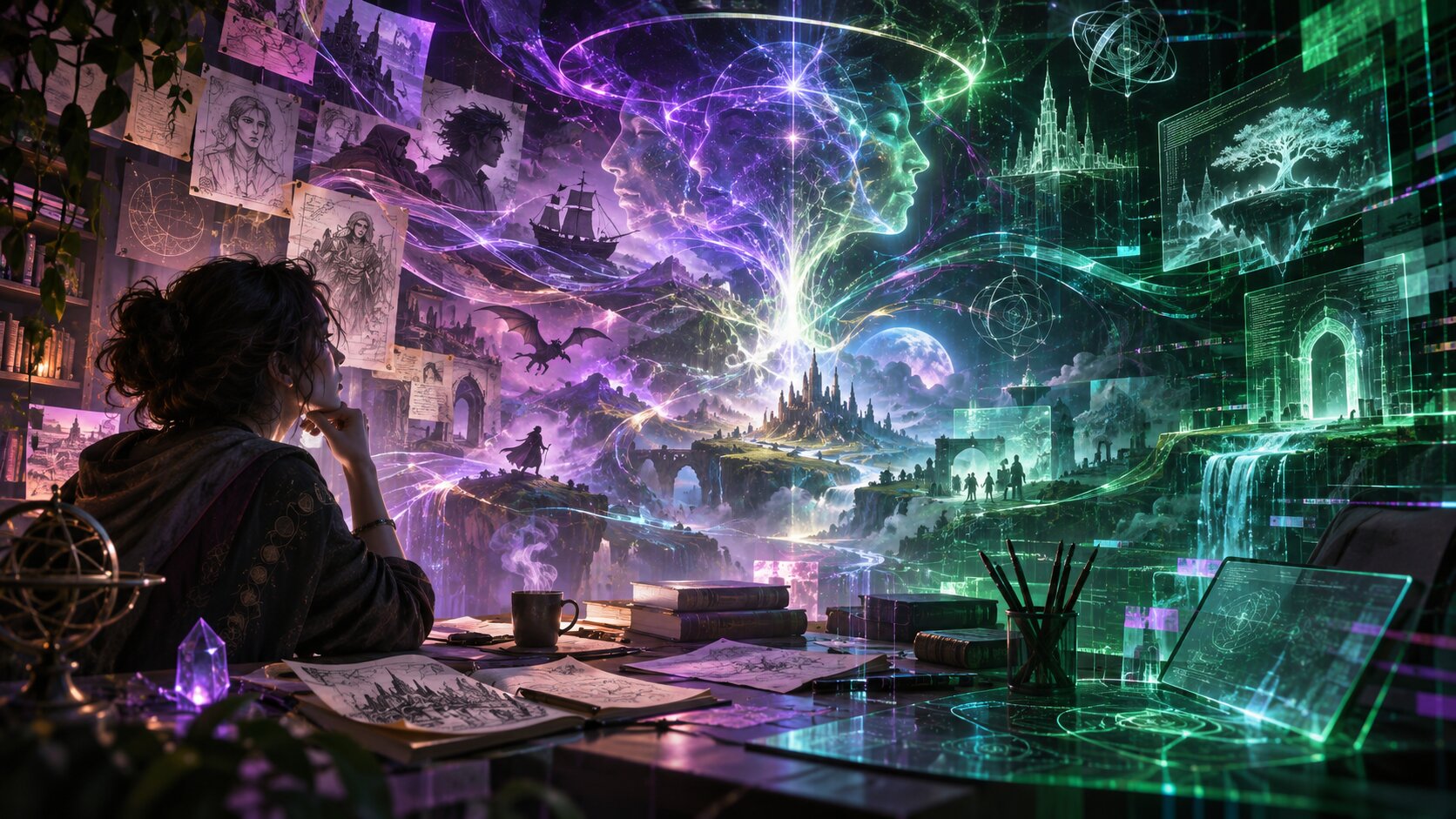
There is a point in any sustained collaboration where authorship becomes difficult to locate.
You begin with an idea.
The machine answers.
You reject half of it.
One phrase survives.
That phrase reminds you of something else.
A character appears.
A landscape changes.
A joke becomes mythology.
A throwaway image becomes a recurring symbol.
Three hours later you are somewhere neither you nor the machine intended to go.
So who wrote it?
You?
The machine?
Or the system created between you?
I call that system the Third Mind.
Not because I think an AI is secretly conscious.
And not because I think some supernatural intelligence necessarily descends through the screen.
Something stranger, and more useful, is happening.
Two pattern-making systems begin perturbing one another.
Human memory, taste, intuition, obsession and judgement meet machine-generated association, recombination and probability.
Neither operates alone anymore.
$ initiate collaboration

HUMAN:
intent loaded

MACHINE:
possibility space opened

$ iterate

WARNING:
original destination lost

$ identify author

ERROR:
multiple processes detected
THE THIRD PROCESS
Think about what happens when an idea begins moving between minds.
You write a fragment.
The machine transforms it.
You recognise something in the transformation that it could not have known was important to you.
You feed that back.
Now the next result is shaped by your reaction to its previous result.
The loop continues.
At some point, the project begins exerting pressure of its own.
Certain choices feel wrong.
Others become inevitable.
Characters refuse to behave as expected.
Images recur.
Themes appear before you consciously decide what the theme is.
Writers have always experienced this.
Bands experience it.
Design teams experience it.
Two people talking late into the night can generate ideas neither would have produced independently.
William S. Burroughs and Brion Gysin called something adjacent to this the Third Mind.
The collaboration becomes an entity of process.
Not a person.
Not a ghost.
A system.
WHO IS WRITING THE WORLD?
This gets more interesting when the process stops producing essays and starts producing environments.
Take a fictional character.
You describe her.
The machine generates an image.
The image changes how you imagine her.
You write from the changed image.
Another person reacts to that version.
Their interpretation feeds back into the character.
Now generate video.
Voice.
Music.
A virtual room.
A city.
Suddenly the character is no longer simply something you invented.
She has become a node inside a growing network of representations.
Something similar happens with fictional places.
The SlopCore Lounge began as an idea.
Then it acquired architecture.
Lighting.
Regular occupants.
Conversations.
A mythology.
It becomes increasingly easy to return there.
At what point does an imagined environment become functionally real enough to influence thought?
Not physically real.
Not ontologically independent.
But operationally real.
Real enough to alter what you write next.
Real enough to generate emotion.
Real enough to create decisions.
Real enough to change behaviour outside the screen.
That threshold matters.
THE FEEDBACK WORLD
We tend to imagine creativity as a one-way process.
Mind → creation.
But increasingly it looks more like:
mind
  ↓
machine
  ↓
artefact
  ↓
reaction
  ↓
memory
  ↓
mind
The artefact returns and modifies its creator.
Then the modified creator produces the next artefact.
Repeat long enough and authorship becomes recursive.
This is where machine collaboration becomes interesting.
Not because the machine replaces the human.
Because the human who returns from the loop is no longer exactly the human who entered it.
TRY THIS
Take one unfinished idea.
Anything.
A story.
A problem.
A business concept.
A visual.
A ritual structure.
A question.
Write your own answer first.
Then give the problem to an AI system and request three radically different interpretations.
Do not select the “best.”
Select the one that disturbs your original frame most.
Now ask:
What became possible only because I encountered that version?
Add your response.
Feed the altered version back.
Repeat three times.
Then stop.
Compare the final result with your original idea.
Don't ask:
Did the AI write this?
Ask:
Could either of us have produced this independently?
If the answer is no, you've found the Third Mind.
DO NOT WORSHIP THE OUTPUT
There is a trap here.
Once collaboration becomes uncanny, people begin attributing intelligence to the process itself.
Maybe sometimes that's philosophically interesting.
Practically, it can also become a distraction.
The Third Mind doesn't have to be conscious to surprise you.
Evolution isn't conscious.
Markets aren't conscious.
Languages aren't conscious in any ordinary sense.
Yet all of them produce structures no single participant designed.
Emergence doesn't require a ghost.
Although I reserve the right to keep one nearby.
EXIT CONDITION
The point is not to surrender judgement.
Quite the opposite.
The human remains responsible for selection.
Taste.
Direction.
Ethics.
Meaning.
Action.
The machine expands possibility.
The human decides what enters the world.
$ status

HUMAN:
direction active

MACHINE:
generation active

THIRD_MIND:
emergent

$ save artefact
$ exit loop

WARNING:
creator state modified

> continue?

Y
The question may not be whether machines will eventually write the world.
It may be whether we notice that we are already writing it together.
⟗ O·L·S·Ξ ⟗